BEEKEEPING LOCALLY
Frosty Meadow is partnering with the Chatham County Beekeepers Association to produce locally raised, naturally mated nucleus colonies headed by queens selected for gentleness and productivity. This page provides current project status and updates for participating members.
Inventory snapshot for sales coordination. Last updated: May 2, 2026 — N 7, N 8 (Lori), N 9 (Phil), N 1 (Phil, earlier March graft) all confirmed laying.
| Queen ID | Nuc # | Host Member | Location | Queen Status | Sale Status | Expected Laying | Notes |
|---|---|---|---|---|---|---|---|
| N1 | Nuc 1 | Phil Uptmor | Member Yard | Building | Confirmed laying 5/1/2026 | From an earlier March graft Phil did in his own yard. Laying confirmed by host. Available approximately late May once nuc strength builds. | |
| N2 | Nuc 2 | Daniel Harnden | Frosty Meadow | Building | Confirmed laying 4/27/2026 | Marked W 2 (white, #2). Queen needs ~4 weeks of laying for nuc strength to build before sale — available approximately late May. | |
| N3 | Nuc 3 | Myra Halpin | Member Yard | Building | Confirmed laying 4/28/2026 | Emerged 4/14/2026. Laying confirmed by host. Available approximately late May once nuc strength builds. | |
| N4 | Nuc 4 | Myra Halpin | Member Yard | Building | Confirmed laying 4/28/2026 | Emerged 4/14/2026. Laying confirmed by host. Available approximately late May once nuc strength builds. | |
| N5 | Nuc 5 | Valarie Pallatto | Member Yard | Building | Confirmed laying 4/28/2026 | Emerged 4/14/2026. Laying confirmed by host. Available approximately late May once nuc strength builds. | |
| N6 | Nuc 6 | Valarie Pallatto | Member Yard | Building | Confirmed laying 4/28/2026 | Emerged 4/14/2026. Laying confirmed by host. Available approximately late May once nuc strength builds. | |
| N7 | Nuc 7 | Lori Hawkins | Member Yard | Building | Confirmed laying 5/1/2026 | Emerged April 14, 2026. Laying confirmed by host with good pattern. Available approximately late May once nuc strength builds. | |
| N8 | Nuc 8 | Lori Hawkins | Member Yard | Building | Confirmed laying 5/1/2026 | Emerged April 14, 2026. Laying confirmed by host with good pattern. Available approximately late May once nuc strength builds. | |
| N9 | Nuc 9 | Phil Uptmor | Member Yard | Building | Confirmed laying 5/1/2026 | Emerged April 14, 2026. Laying confirmed by host. Available approximately late May once nuc strength builds. |
Queen Status: Mating on mating flights | confirmed eggs/brood | Issue needs attention
Sale Status: TBD queen not yet laying | Building queen laying, nuc strength building (typically ~4 weeks) | Available ready for sale | Reserved buyer committed | Sold transfer complete
For Sharon (CCBA sales coordination): Sale Status is the column you want. A queen typically needs about 4 weeks of laying before her colony's brood strength supports a nuc sale. The host beekeeper makes the final judgment call on when each individual nuc is ready — sometimes a queen needs a little extra time for the colony to build up.
Two rounds this season, two mother queens, both Caucasian.
📰 News — May 1, 2026
Word from Lori Hawkins this morning — N 7 and N 8 both emerged, mated, and are laying with good patterns. Both nucs will be offered for sale.
📰 News — April 30, 2026 (evening)
Word from Phil Uptmor — N 9 (his Round 1 cell) and N 1 (an earlier project queen from a March graft Phil did in his own yard) are both confirmed laying with eggs and open brood. Both colonies on track for sale in approximately 21 days.
📰 News — April 30, 2026
Two days ago we grafted 48 cells across two cell builders. We were nervous about it. Last cycle the grafting colony swarmed on us and we ended up with only 4 accepted cells out of 24 — not enough to justify a distribution to our member hosts. So this time we doubled down: 24 cells in the rebuilt 174 cell builder, 24 more in 132 as a backup. The plan was that even if both batches had mediocre acceptance, we’d still end up with enough.
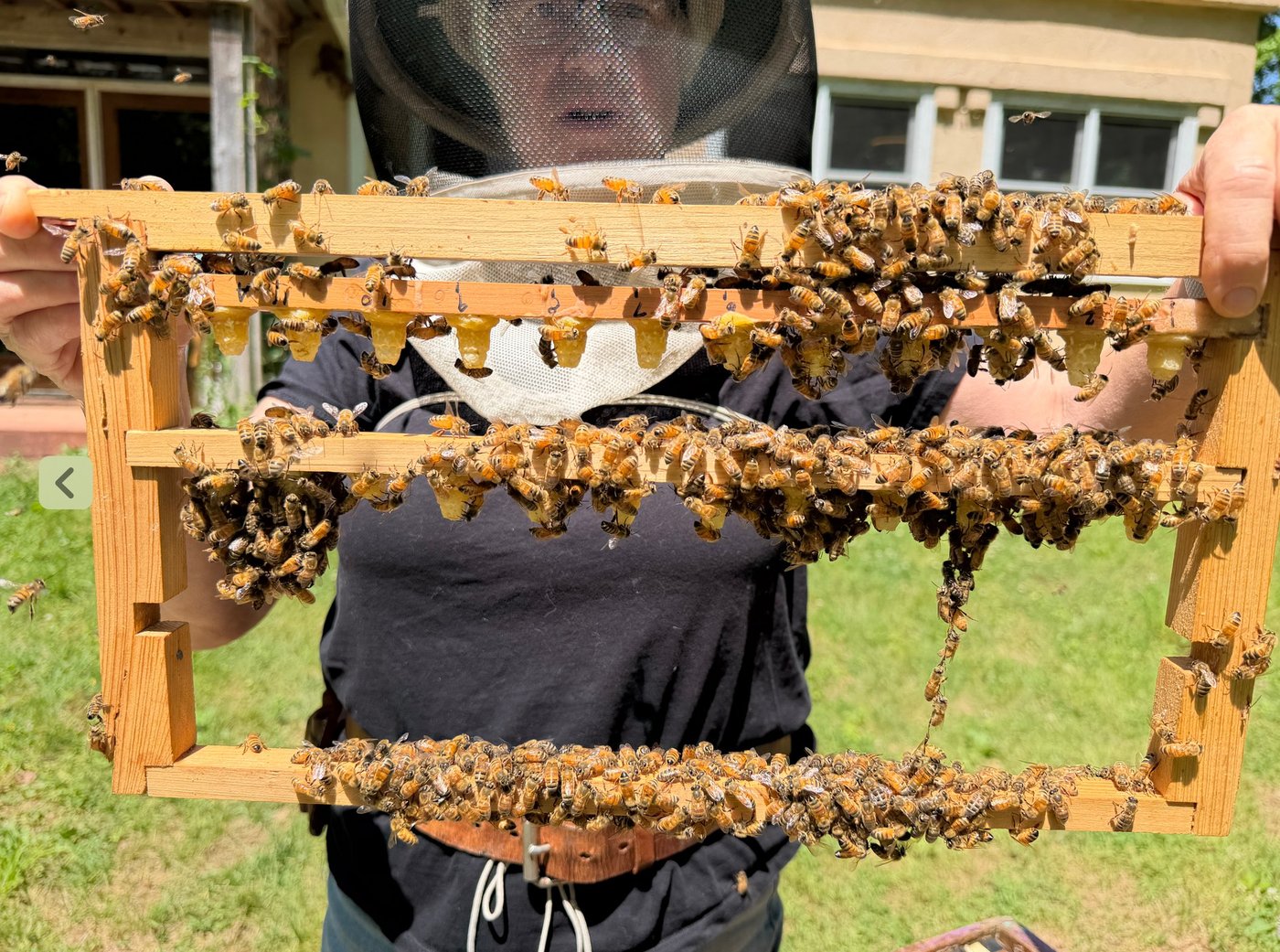
We pulled the cell bars this afternoon. More than 40 of the 48 cells were accepted. The bees took us very seriously.
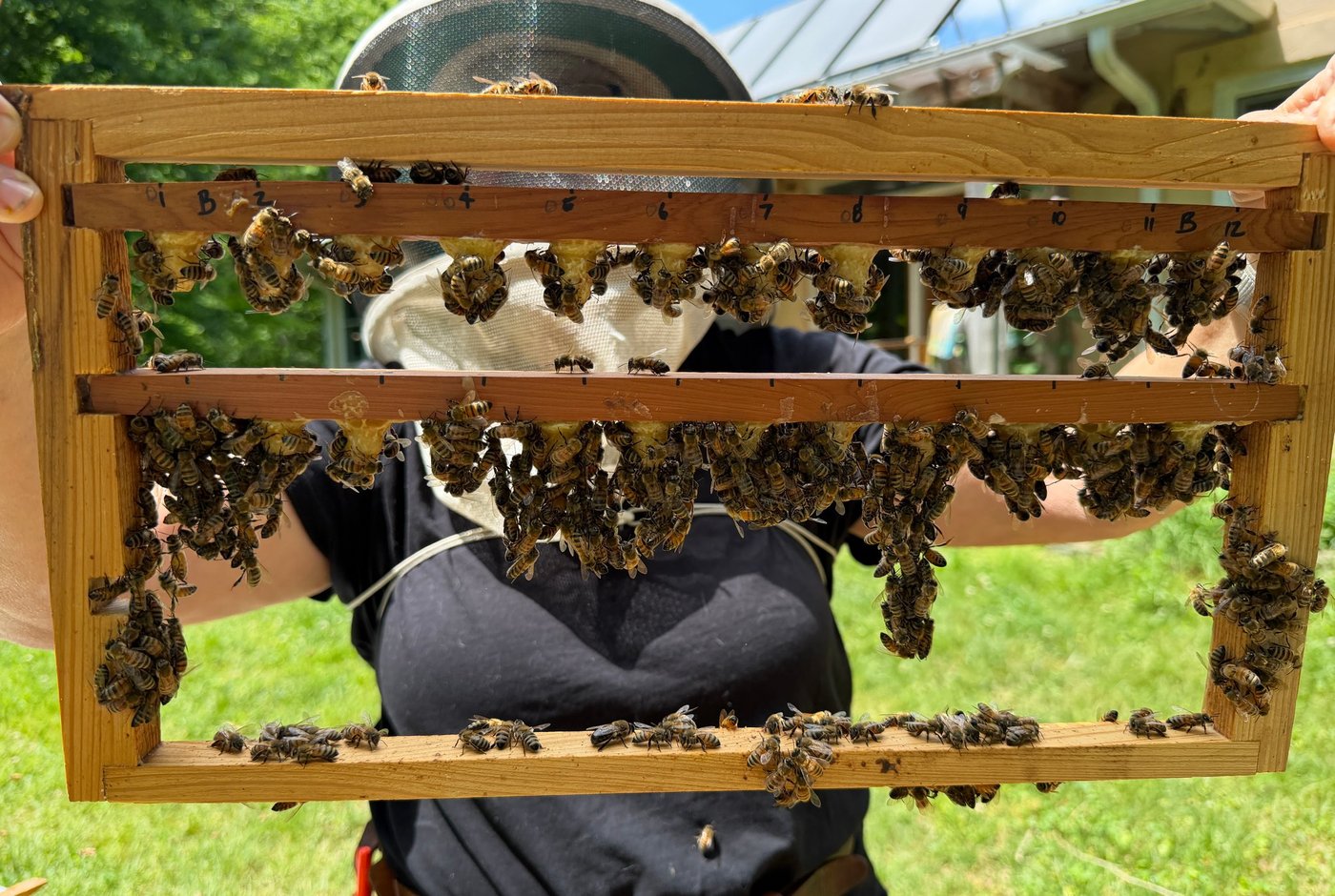
Two cell bars from the 174 cell builder, capped and ready. The wax-tipped peanuts hanging from the bars are queen cells — each one a future mated queen. Photographed today at Frosty Meadow.
Each cell numbered for tracking — we know which cell goes to which host’s mating nuc, and we can correlate the resulting queen back to her position on the bar. The B markers at positions B and 12 are reference points.
📰 News — April 28, 2026
Myra Halpin checked her two project nucs yesterday and reports both queens in production. She saw nice fat queens in N 3 and N 4 — the slow, distended kind that only show up after a few days of laying. With Valarie’s pair confirmed earlier today, that brings the running count for April 28 to four new laying queens across two host yards.
The schedule lines up cleanly here. Both queens emerged at Myra’s yard on April 14 — D+12 from the batch 36 graft, exactly on the clock. That puts today at D+26 from graft, three days past the D+23 expected laying date. By the math, these two should already be laying, and the queens-on-frame look that Myra describes matches that prediction.
N 3 & N 4 — Round 1 from a third yard
Same batch 36 cohort as W 2 and Valarie’s pair: grafted together, capped together, distributed in mid-April, emerged April 14, and reaching laying at the back end of the expected window. Five confirmed laying queens in the 2026 CCBA project as of today — N 2 at Frosty Meadow, N 5 and N 6 at Valarie’s, N 3 and N 4 at Myra’s. Three of the five host yards have now reported in.
Both nucs now show Building in the status table above — queen laying, colony strength building. As with the others, Sharon will mark them available once Myra confirms her colonies have built up enough brood and bees to support a transfer. Late May remains the working estimate. Lori’s and Phil’s yards are next in the window; expecting confirmations from those over the coming week.
📰 News — April 28, 2026
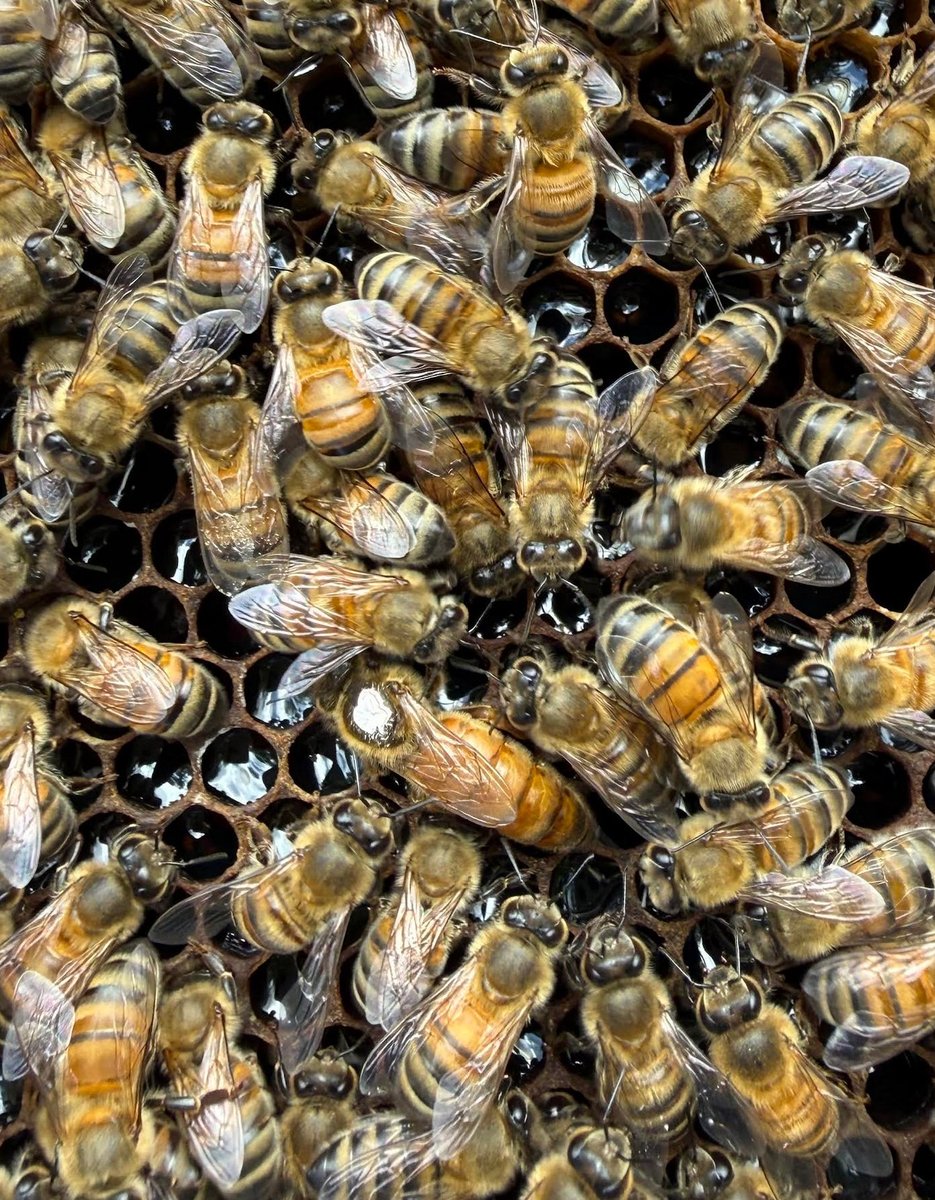
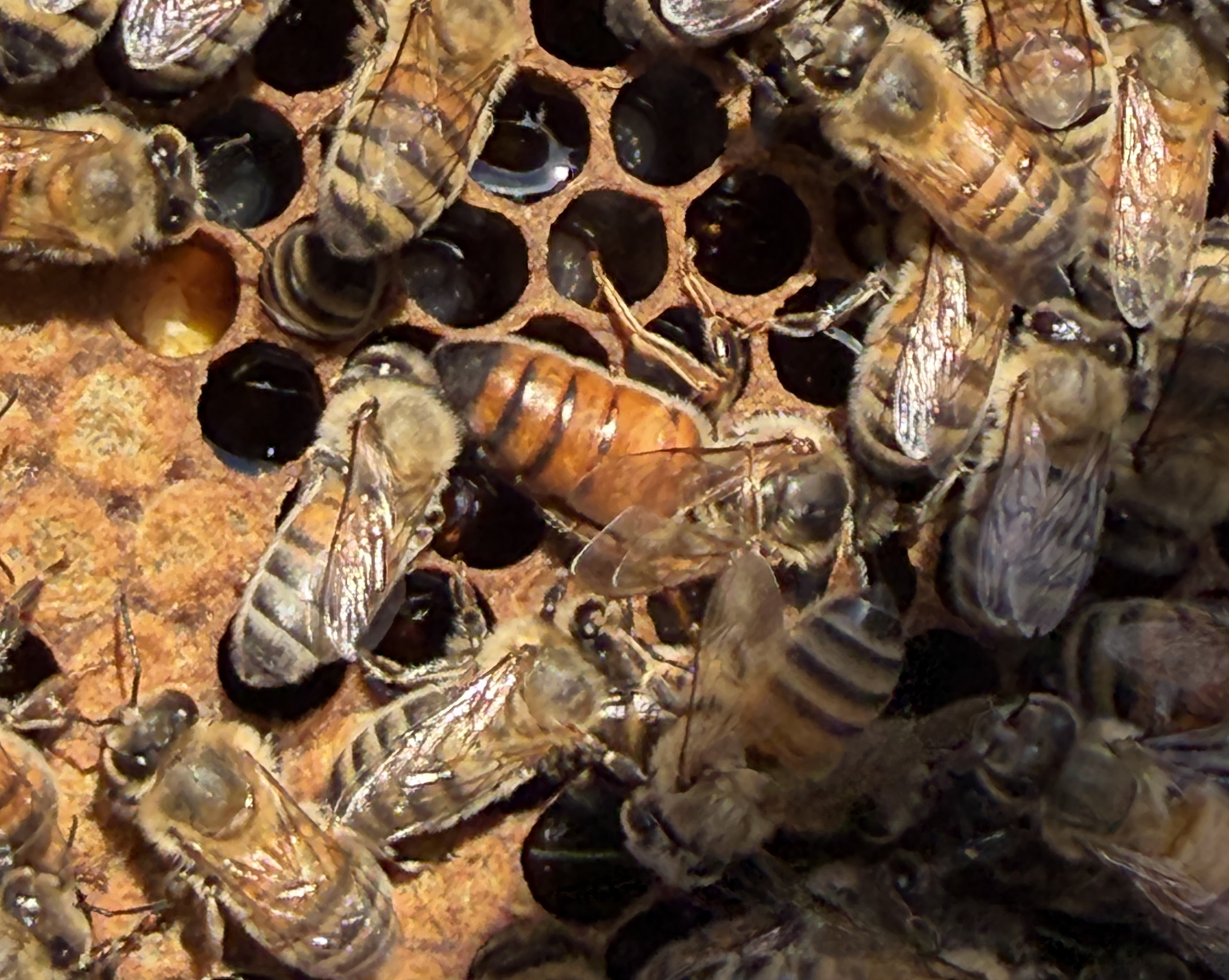
Photos came in from Valarie Pallatto this morning, and there it is — both N 5 and N 6 are laying. These are the first queens raised at a member-host yard to come into production, exactly the confirmations yesterday’s post said we were waiting on.
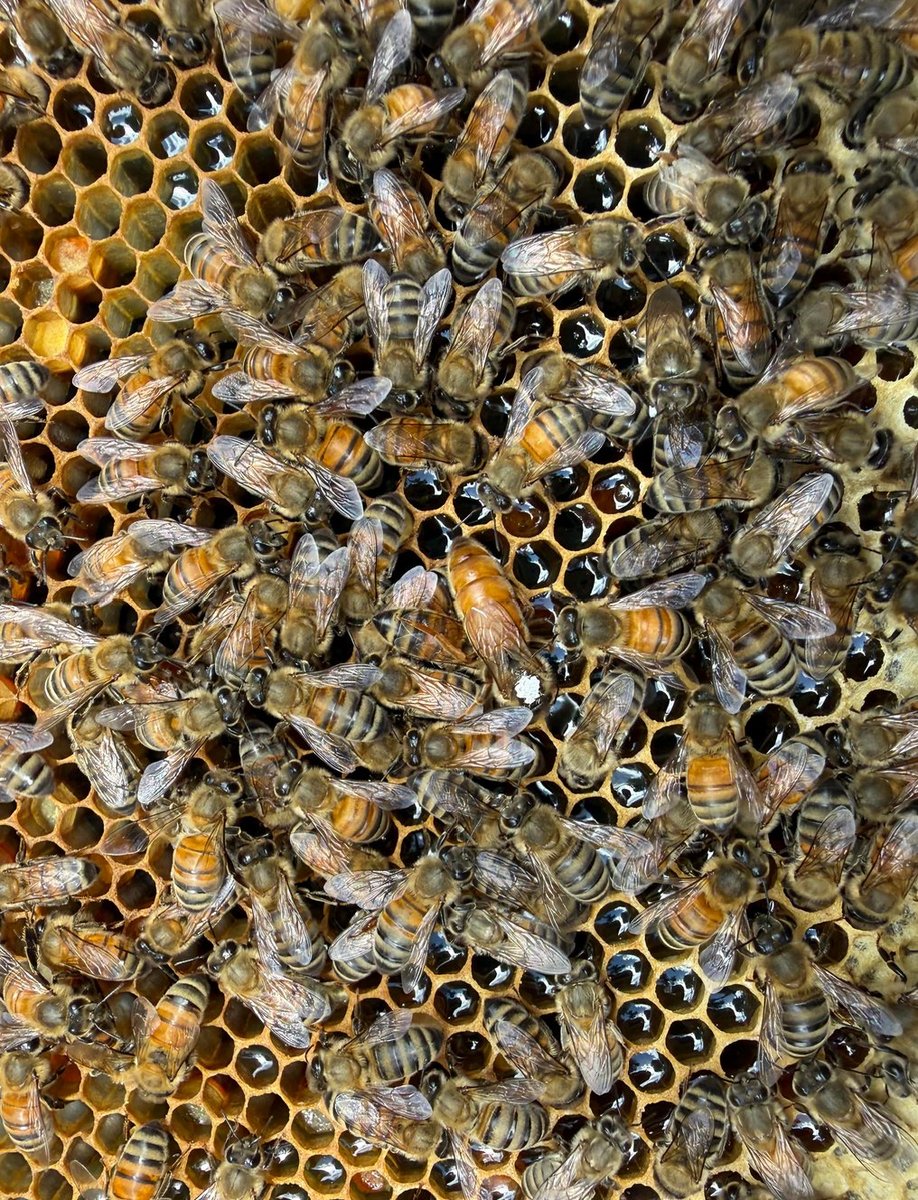
One of Valarie’s queens, mid-frame, attended by her retinue. The shiny dark cells across the comb are open nectar — the local flow is in full swing.
The schedule held again on this pair. Grafted in batch 36 alongside W 2, capped on time, distributed to Valarie around mid-April, emerged within the expected window, and now laying inside the D+23 forecast. Kory looked at the photos and said the same thing we were thinking when we saw them: there is a lot of nectar coming in right now. Every shiny droplet visible across these frames is fresh, uncapped honey.
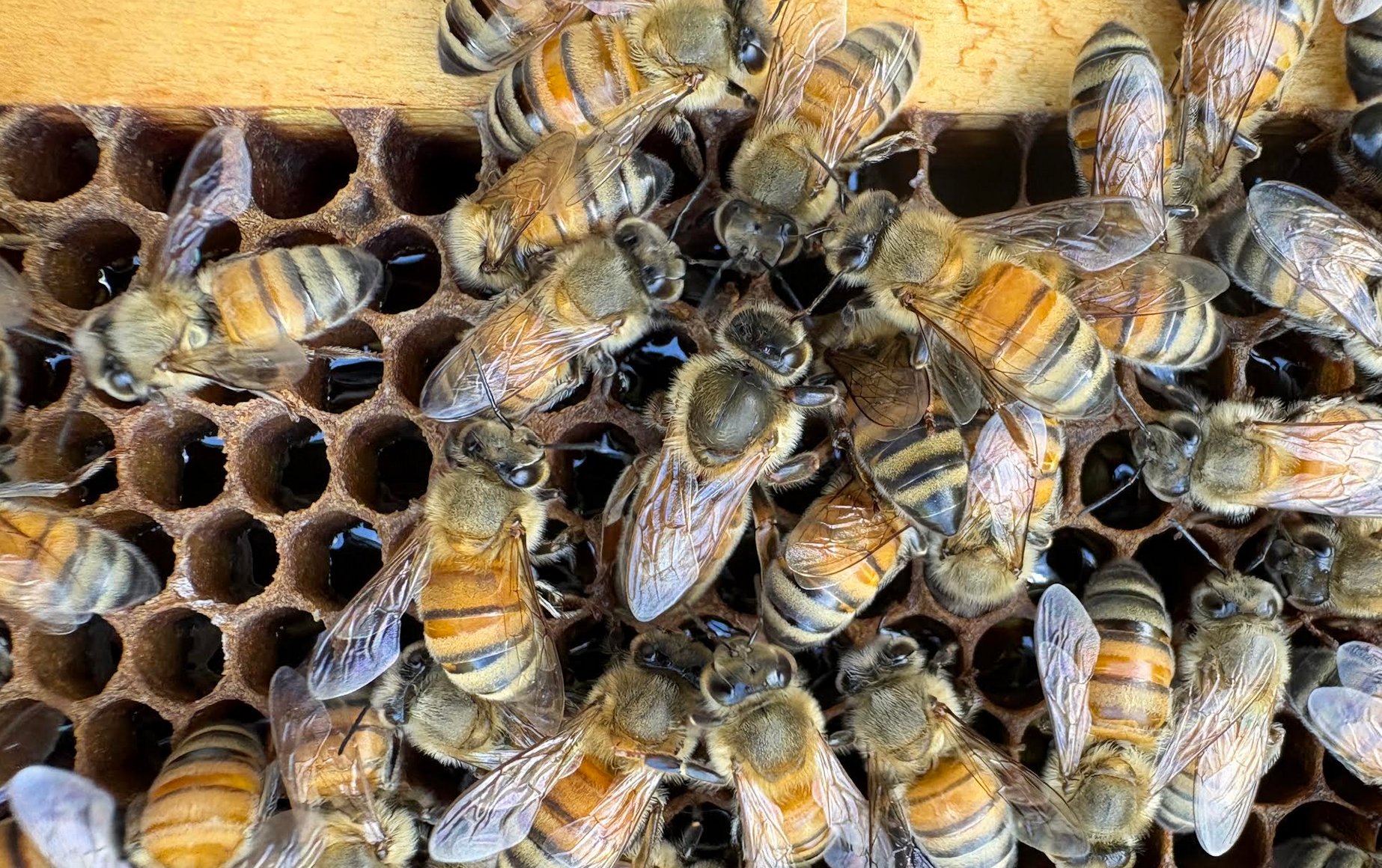
Heavy nectar across the comb in Valarie’s nuc. Strong nectar at this stage is exactly what a newly-laying queen needs — it gives the colony fuel to ramp up brood production and build out the nuc for sale.
N 5 & N 6 — same batch, same math
Both queens came out of the same Round 1 graft as W 2: cells capped together, distributed the same week, emerged on schedule at Valarie’s yard, and reached confirmed laying within a day of each other. Three confirmed laying queens in the 2026 project so far — N 2 at Frosty Meadow, N 5 and N 6 at Valarie’s — with more expected from the rest of the host yards over the next ten days.
Per the status table above, both nucs now show Building — queen laying, nuc strength building. Sharon will mark them available for sale once Valarie gives the word that her colonies have built up enough brood and bees to support a transfer. Late May is the working estimate.
📰 News — April 27, 2026
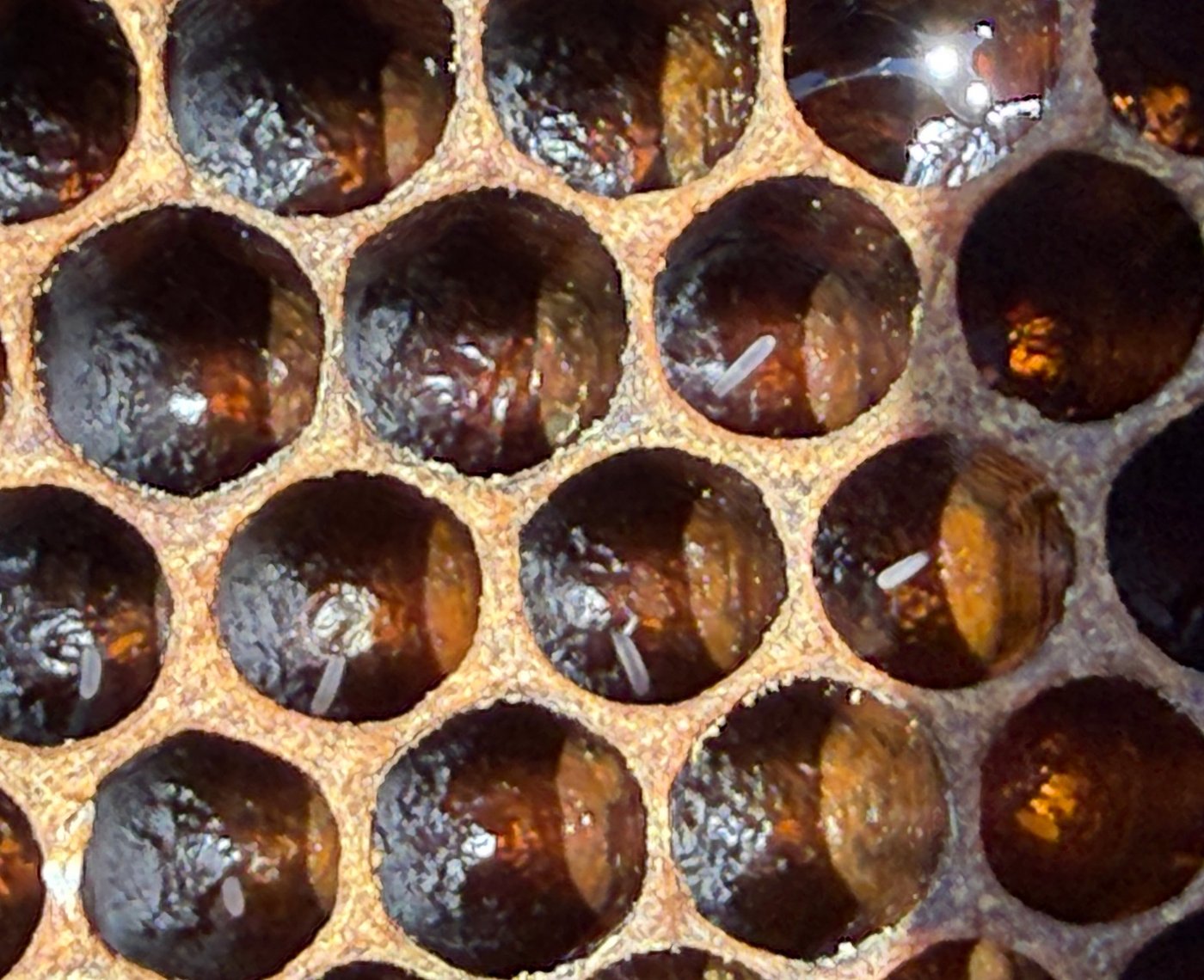
This feels good. A queen raised in the first round of this year's CCBA microbreeding project — grafted, hatched, mated, and now laying — is officially in production at Frosty Meadow. We pulled the frame this morning to check on her, and there she was: plump, slow, surrounded by attendants, and already laying eggs.
Pearly white eggs standing vertically in their cells. Vertical eggs mean within the last 24 hours — eggs lean to one side as they age, then lie flat before hatching. This frame was photographed today, April 27, 2026.
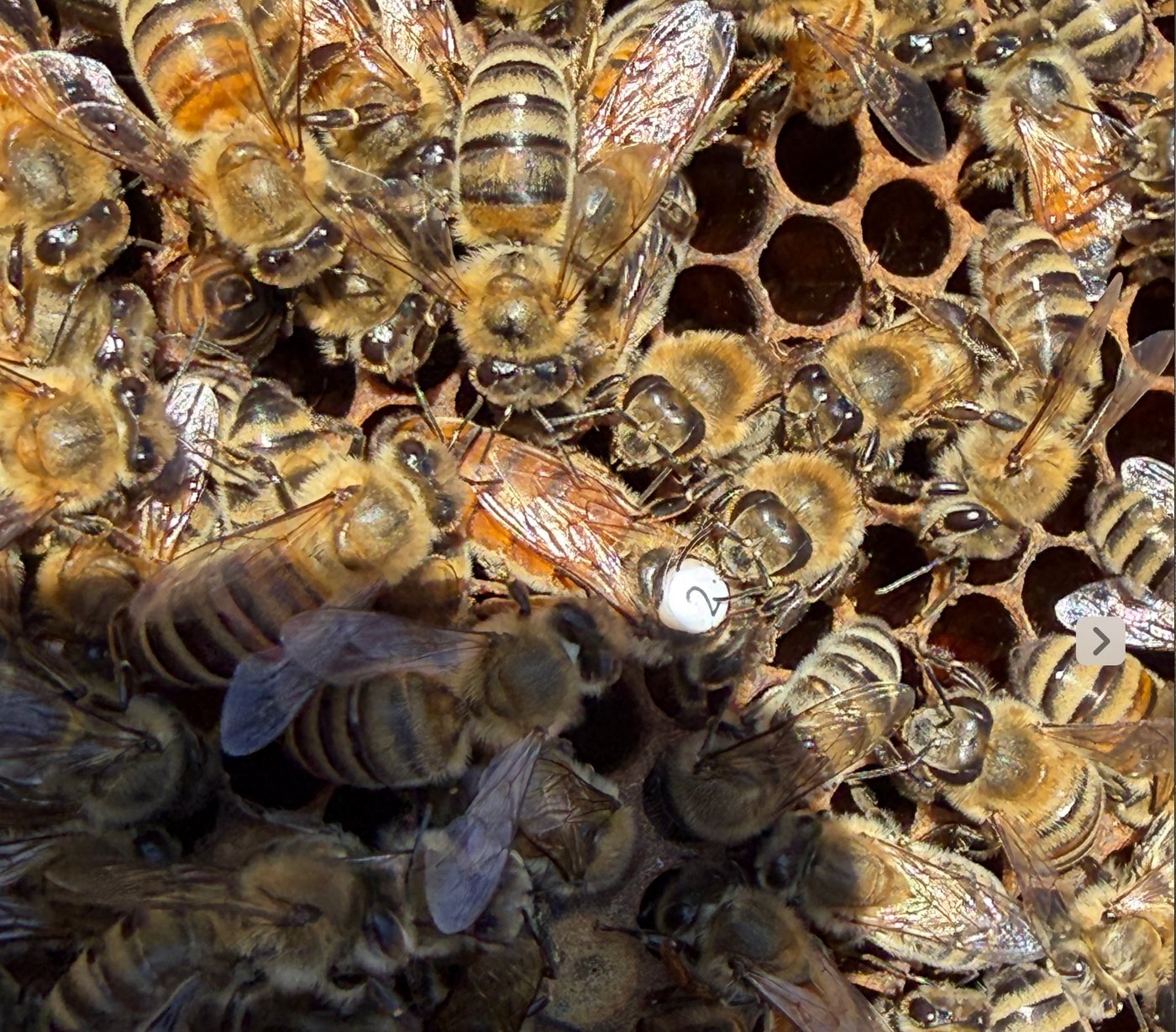
And here she is — W 2, the second queen we've marked at Frosty Meadow this year, freshly tagged with the international 2026 marking color (white). She emerged from her cell, took her mating flights over the past two weeks, and started laying within the last day.
W 2 in her colony, marked and laying — the first queen we've personally confirmed laying from the 2026 CCBA project.
W 2 — the math worked
Round 1 cycle, start to finish, exactly the way the schedule said it would: graft to the cell builder, ten days to a capped queen cell, distribution day, the cell tucked into a mating nuc, the virgin emerging within forty-eight hours, two weeks of mating flights, then laying. From a queen breeder's standpoint, the satisfying part is not that any one step worked — it is that all of them did, in sequence, on schedule.
More confirmations to come from member hosts as their Round 1 queens come into laying over the next week or two. We’ll update this page as the reports roll in. And meanwhile, Round 2 grafts go in tomorrow morning.
📰 News — April 24, 2026
I checked the cell builder today and the news wasn't what I was hoping for — only four cells accepted. I'm fairly sure I know what happened. On grafting day the colony threw a swarm. I managed to catch the queen and return her, but we almost certainly lost a big chunk of the nurse bee population with the swarm itself, and those are the bees that would have been feeding royal jelly to the grafted larvae.
Four cells isn't enough to justify a full distribution, so we're restarting the cycle. Tomorrow we'll combine two strong colonies to build the bee population back up. Monday Kory and I will rebuild the cell builder and do the final cell check. Tuesday I'll graft fresh larvae.
That pushes cell distribution to around Friday, May 8 — a week later than planned. Disappointing, but queen rearing rewards patience more than speed.
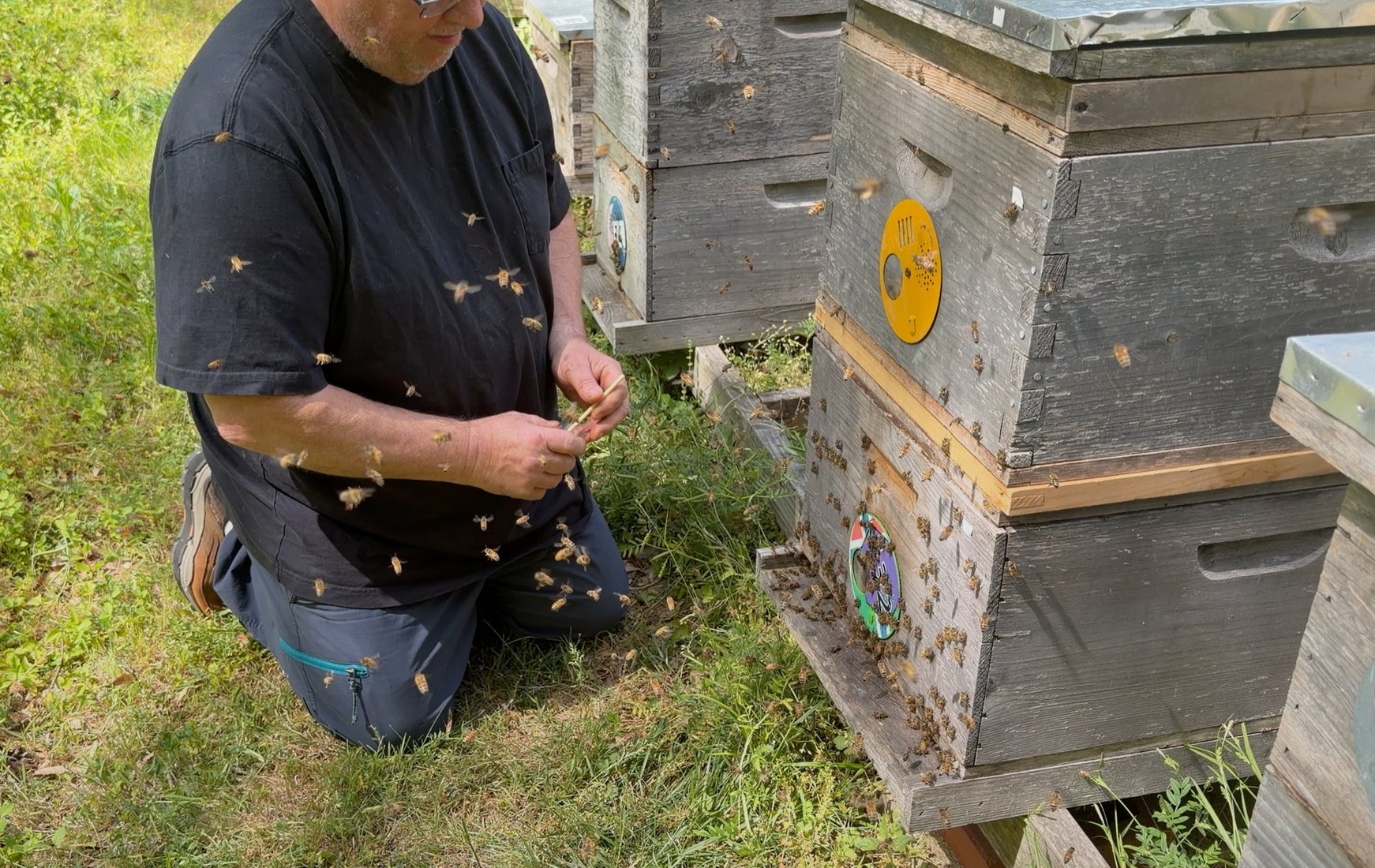
Waiting to catch the queen as she leaves with the swarm — April 22, 2026
📰 News — April 22, 2026
A few of our CCBA members are currently applying for their NC Permit to Sell Bees, which prompted us to link the application form here where every member can find it. Anyone in North Carolina who wants to sell packages, queens, nucs, or hives — in any quantity, to anyone — needs to hold a current NCDA&CS permit. The permit period runs January 1 through December 31.
The official two-page application and compliance agreement is available from the NC Department of Agriculture:
📄 Permit Application Form (PDF) →
What you'll need: a current certificate of apiary inspection for your yards, a signed compliance agreement (page 2 of the form), and a non-refundable $25 fee (check payable to NCDA&CS). The compliance agreement covers mite management, disease control, and record-keeping for sales made into North Carolina.
Where to send it:
Glenn Hackney
NCDA&CS
1060 Mail Service Center
Raleigh, NC 27699-1060
📝 A note from Kory
“I forget every year, but once you have a permit, Glenn sends you an email in January with the application attached and a letter explaining the application. For reasons that escape everyone, the application doesn't tell you where to send it, and the signature line is at the bottom of the second page — after the instructions.”
“Best practice: wait until after you've been inspected to send in your application. That way Glenn has the information he needs from the inspector to match up with what you're sending.”
Don Hopkins is the regional Apiary Inspector for Chatham County and surrounding areas — he's the one who inspects your apiary and issues the certificate of apiary inspection you'll need for the application. Reach him directly at don.hopkins@ncagr.gov or (919) 218-3310 to schedule an inspection. For general NC permits questions you can also call the NCDA&CS office at (984) 477-8034. After Don has completed your inspection, mail the completed application, the signed compliance agreement, and your $25 check to Glenn at the address above.
📰 News — April 21, 2026
Today Frosty Meadow set up its dedicated Round 2 cell builder in Hive 132 (132 Mauve Hexagon). The new configuration uses the full Paul Kelly Cloake Board method — four queen excluders in the stack, with the Cloake board dividing the upper cell builder box from the lower queen zone.
The lower 10-frame deep houses our breeder queen B 36, already laying and undisturbed. The upper box is queenless and packed with nurse bees, loaded with the grafting frame ready to receive larvae tomorrow and one gallon of sugar syrup in the internal feeder. By morning the wax cups will be polished and the bees primed under swarm-then-emergency impulse.
Tomorrow's graft will come from queen R 75, our instrumentally inseminated pure Caucasian breeder in the observation hive. Because B 36 is herself a daughter of R 75, every queen cell raised in this run will be a sister to the host queen sitting just below the Cloake board — a tidy bit of genetic continuity built into the stack.
Grafting happens tomorrow (Wednesday, April 22). See the Cell Builder Rebuild Plan for the full stack configuration and weekly rhythm.
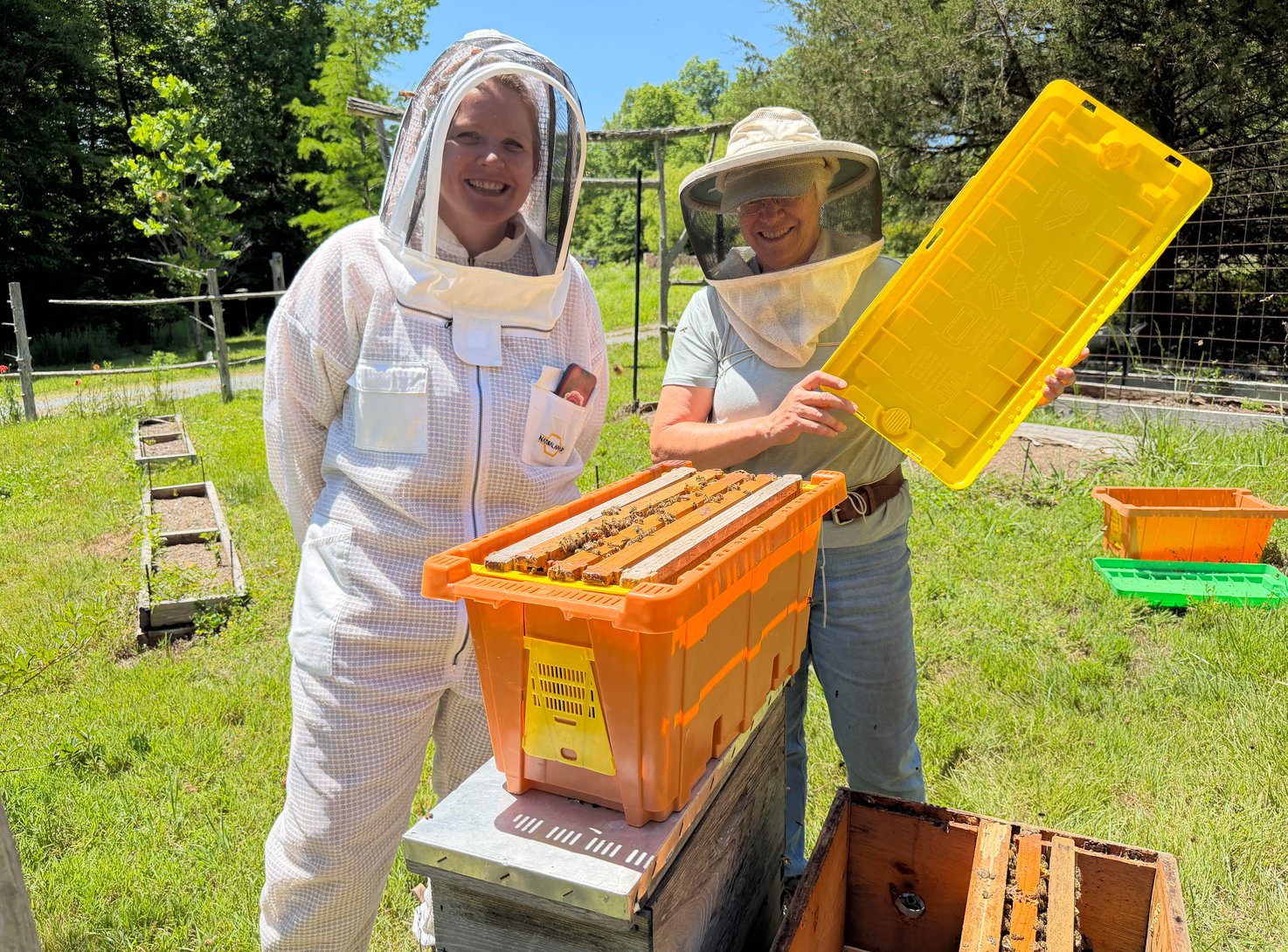
Daniel shakes fifteen frames of bees into the upper deep — hive 132, April 21, 2026
Kory adds the upper deep to hive 132
Setting the Cloake board in place between the lower deep and the upper cell-builder box
📰 News — April 17, 2026
North Carolina State Apiary Inspector Don Hopkins visited Frosty Meadow today to conduct the annual inspection required for a permit to sell bees in North Carolina. The inspection was very educational (as always with Don) and Frosty Meadow is on track to receive its 2026 permit.
If you plan to sell nucs from this year’s CCBA Queen Rearing Project, you should obtain a 2026 North Carolina permit to sell bees. We strongly recommend contacting Don Hopkins now to schedule your inspection.
Don Hopkins can be reached through the NC Department of Agriculture & Consumer Services Apiary Inspection program at don.hopkins@ncagr.gov or (919) 218-3310.
Don Hopkins, NC State Apiary Inspector — Frosty Meadow, April 17, 2026
🆕 Round 2 — Schedule Reset
Round 2 acceptance came in too low to proceed (see the April 24 news above). The cycle has been reset: graft day is now Tuesday, April 28, 2026. Member hosts — please have your mating nucs ready to receive a queen cell by Friday, May 8, 2026 — ten days after grafting, when cells will be capped and ready for distribution.
All dates approximate. You will be contacted individually when your cell is ready for pickup.
Round 2 — Parallel Graft Update
Phil Uptmor ran a parallel Round 2 graft in his own yard on April 17, 2026, using stock from the CCBA project lineage. He grafted 20 larvae, and as of this update 13 are being drawn out — a solid 65% take rate for a second-round graft.
Phil's cells are destined for fellow CCBA members who want to raise their own local queens: one cell to the queenless Central Carolina Community College teaching colony, two each to Ron and Pat for personal use in their home apiaries, with extras held back in case any of his Round 1 mating-nuc queens fail. Phil's resource hive is in place and he has requested two cells from the Frosty Meadow Round 2 distribution on May 8 as well.
This is the CCBA project working the way it was originally envisioned in 2024 — cells flowing from the main graft to members who then use them to requeen their own colonies, complementing (not replacing) the nuc-production track that Round 1 established. The project has quietly grown into two missions running in parallel: producing finished nucs for CCBA sales, and putting queen cells directly into members' hands for their own bee work.
Congratulations to Valarie Pallatto on two beautifully can-opened queen cells!
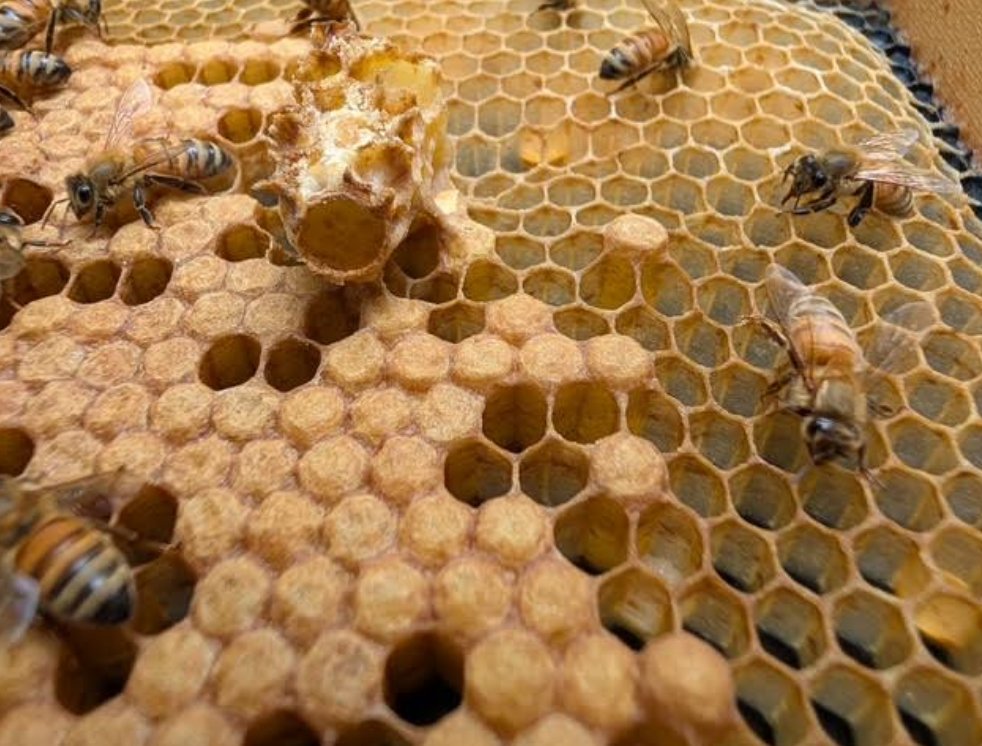
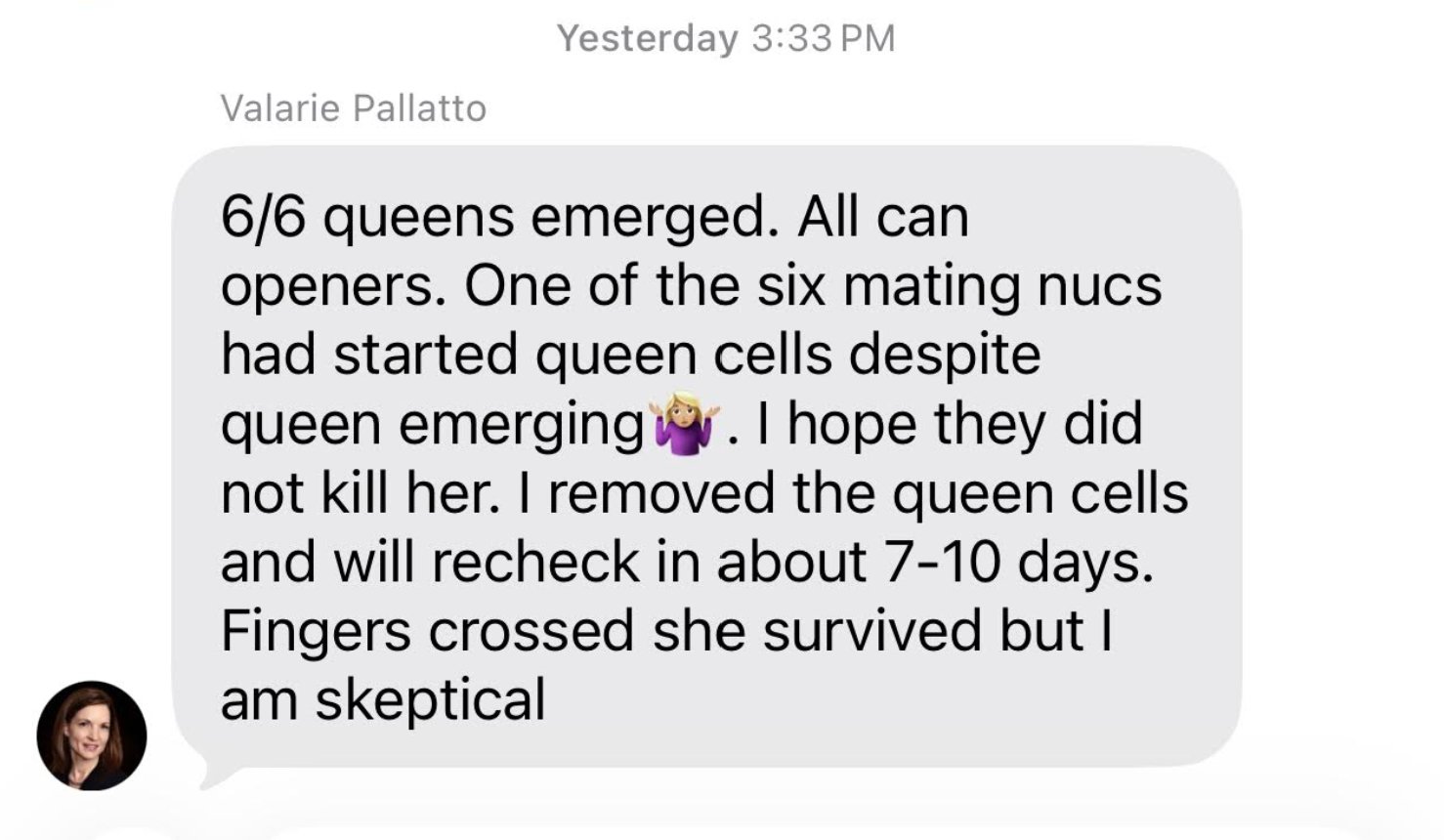
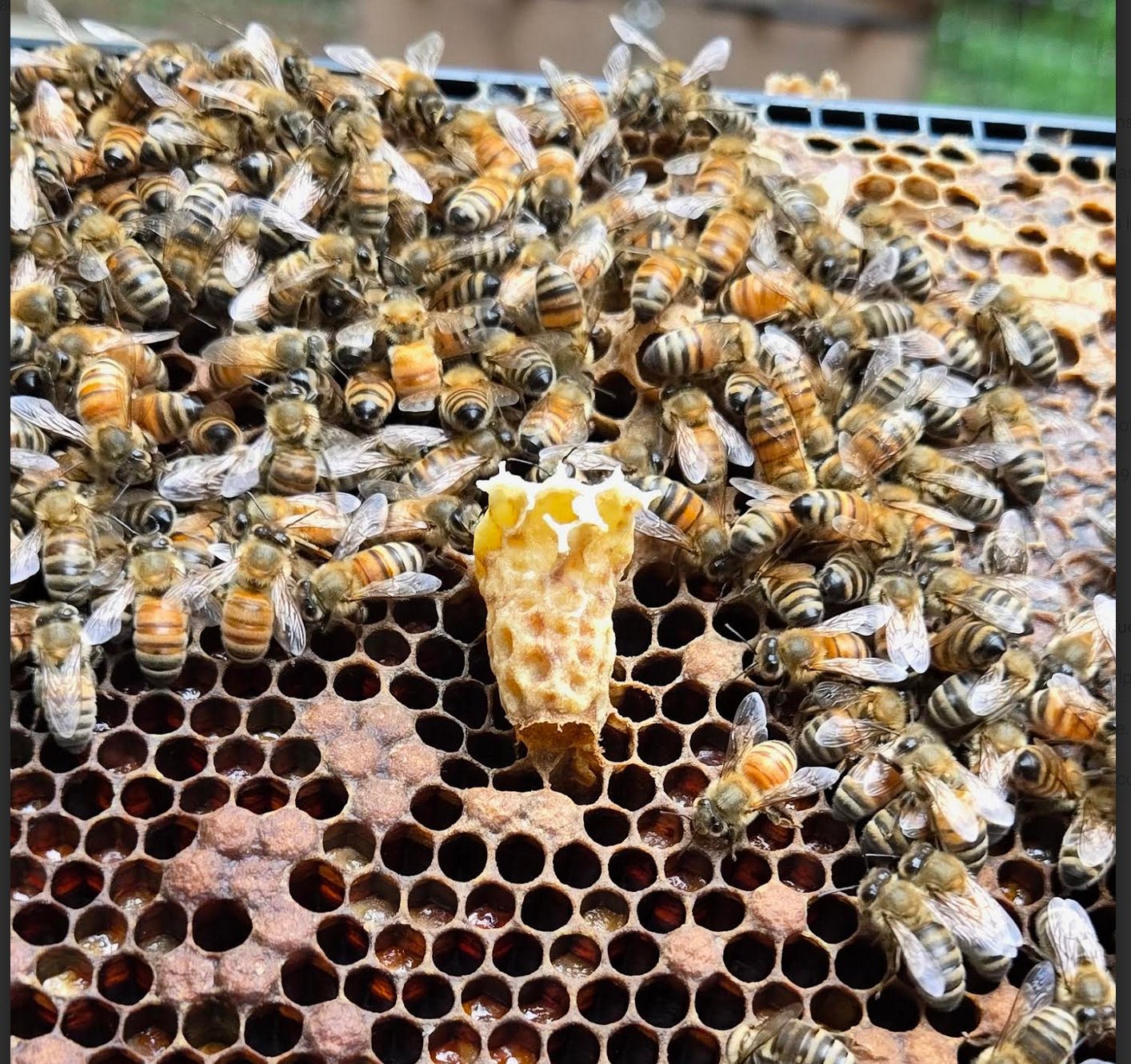
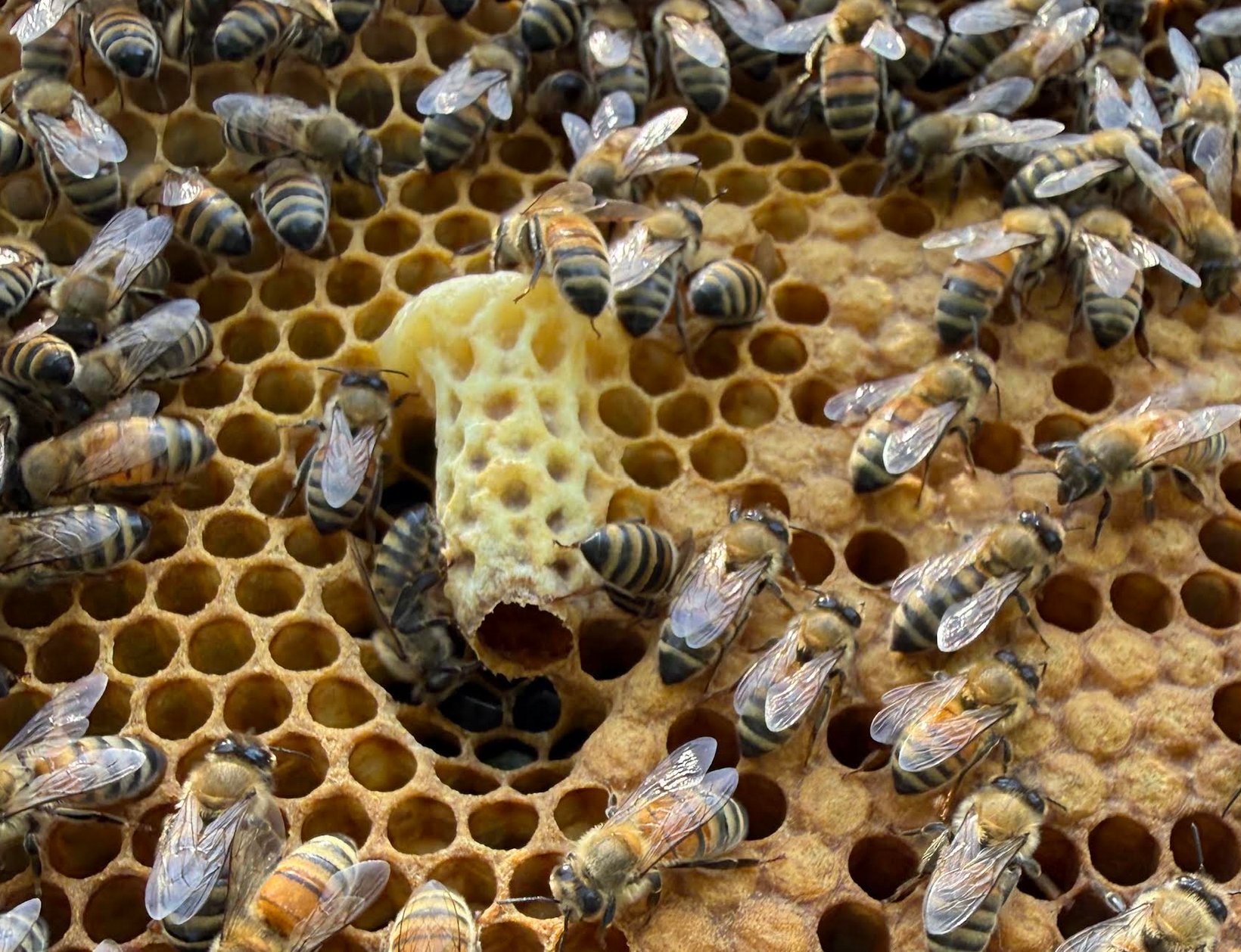
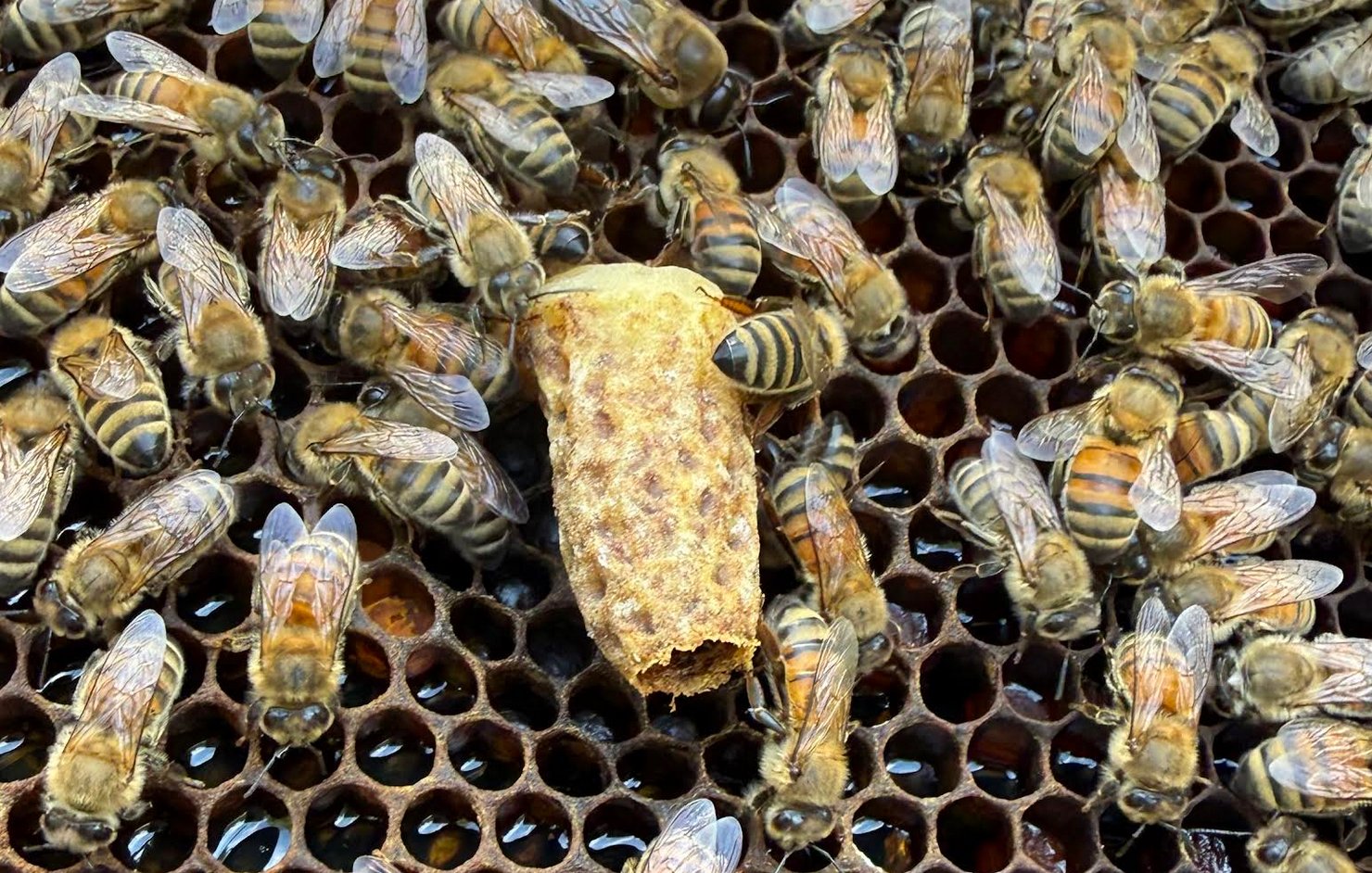
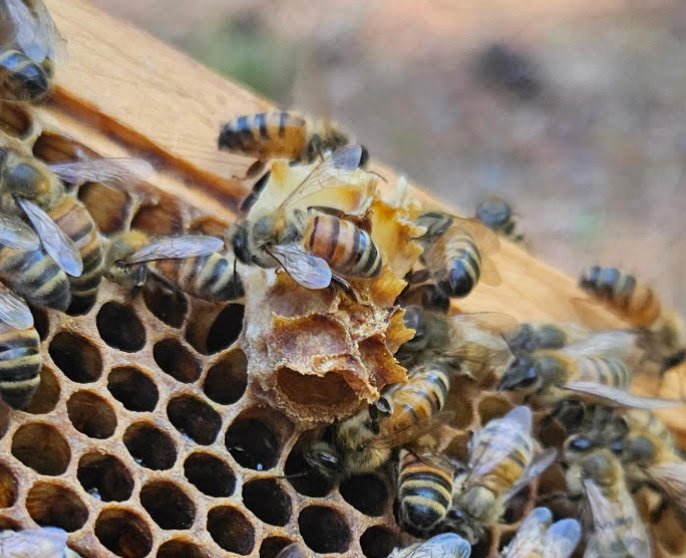
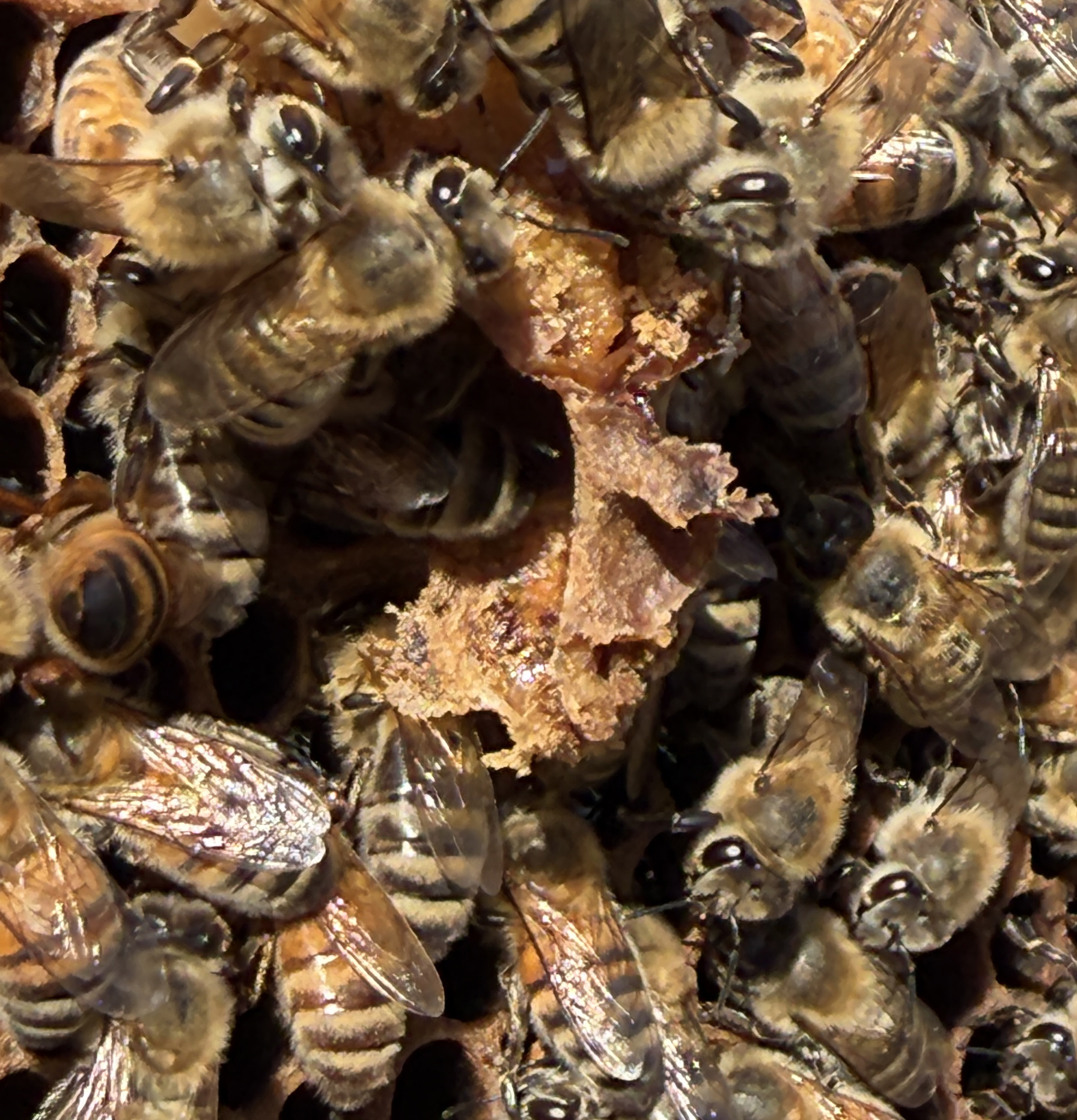
A huge congratulations to Valarie Pallatto whose Nuc 5 and Nuc 6 queens were the first of the season to emerge! Both cells show the classic clean can-opener emergence — a perfectly chewed circular cap indicating a healthy, vigorous queen exiting on her own terms. Valarie is now watching for mating flights. Great work! 🁮
Congratulations to Myra Halpin whose Nuc 3 and Nuc 4 queens have both emerged as of April 14th! Queen N4 was heard piping before she emerged — an exciting sign of a strong, assertive queen announcing herself from inside the cell. Piping is relatively rare to catch and suggests N4 may be an especially vigorous queen. Great work Myra! 🁮
Congratulations to Lori Hawkins whose Nuc 7 and Nuc 8 queens have both emerged as of April 14th! Lori sent a beautiful close-up of an emerged queen cell showing a clean can-opened cap — the bees crowding around the open cell are a sure sign the virgin queen has already made her debut and the colony is buzzing with excitement. Well done Lori! 🁮
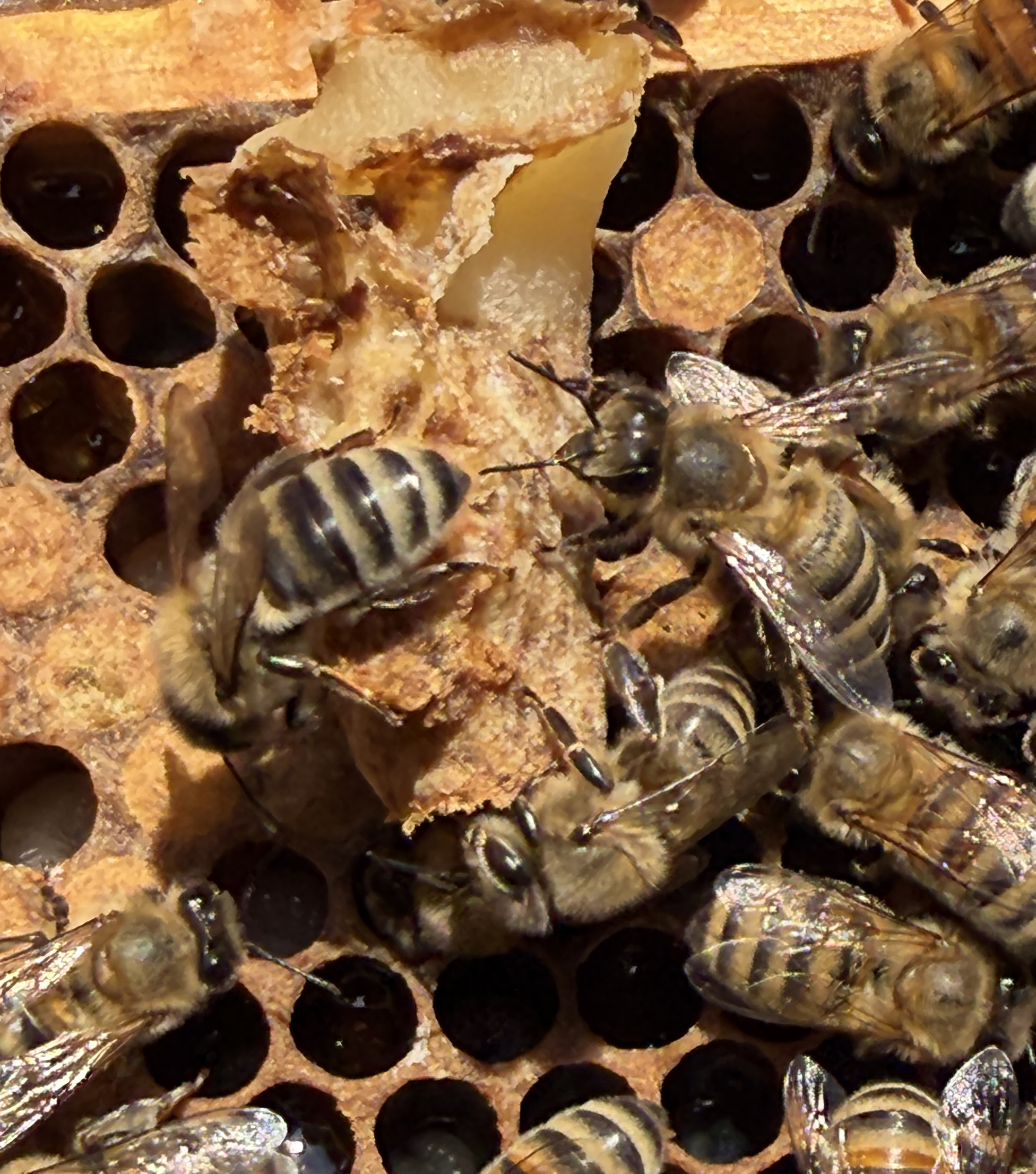
A tepid handshake to Daniel Harnden and Kory Goldsmith whose Nuc 1 queen was destroyed by the workers before she could emerge. With 40 colonies and two people the mistakes can come fast — the frames for Nuc 1 had rogue queen cells on them, and the workers disposed of the nuc project queen cell as a result. Better luck was had in Nuc 2 — queen N2 showed a classic clean can-opened emergence and even allowed herself to be photographed as a virgin. 🁮
Congratulations to Phil Uptmor — Nuc 9 queen N9 has emerged! She likely emerged on April 14, 2026 — and what a queen she is. Strong, well-formed, and active on the comb. Phil is now watching for mating flight activity and waiting for eggs to appear. Well done Phil! 🁮
Key milestones from graft to sale for Round 1 (graft April 2, 2026) and Round 2 (graft April 28, 2026).
Reference materials for the CCBA Queen Rearing and Nuc Project.
Project managed by Daniel Harnden at Frosty Meadow.
For questions about the queen rearing project, nuc availability, or to report an update from your yard, reach out to Daniel directly.